Finding No. 1
5.5 in 100 pay. 1.8 in 100 stay.
1.8% — of short-drama subscribers still paying at six months, against 8% for other Entertainment apps. Source: RevenueCat, Short drama has cracked mobile acquisition and early monetization, 28 August 2026.
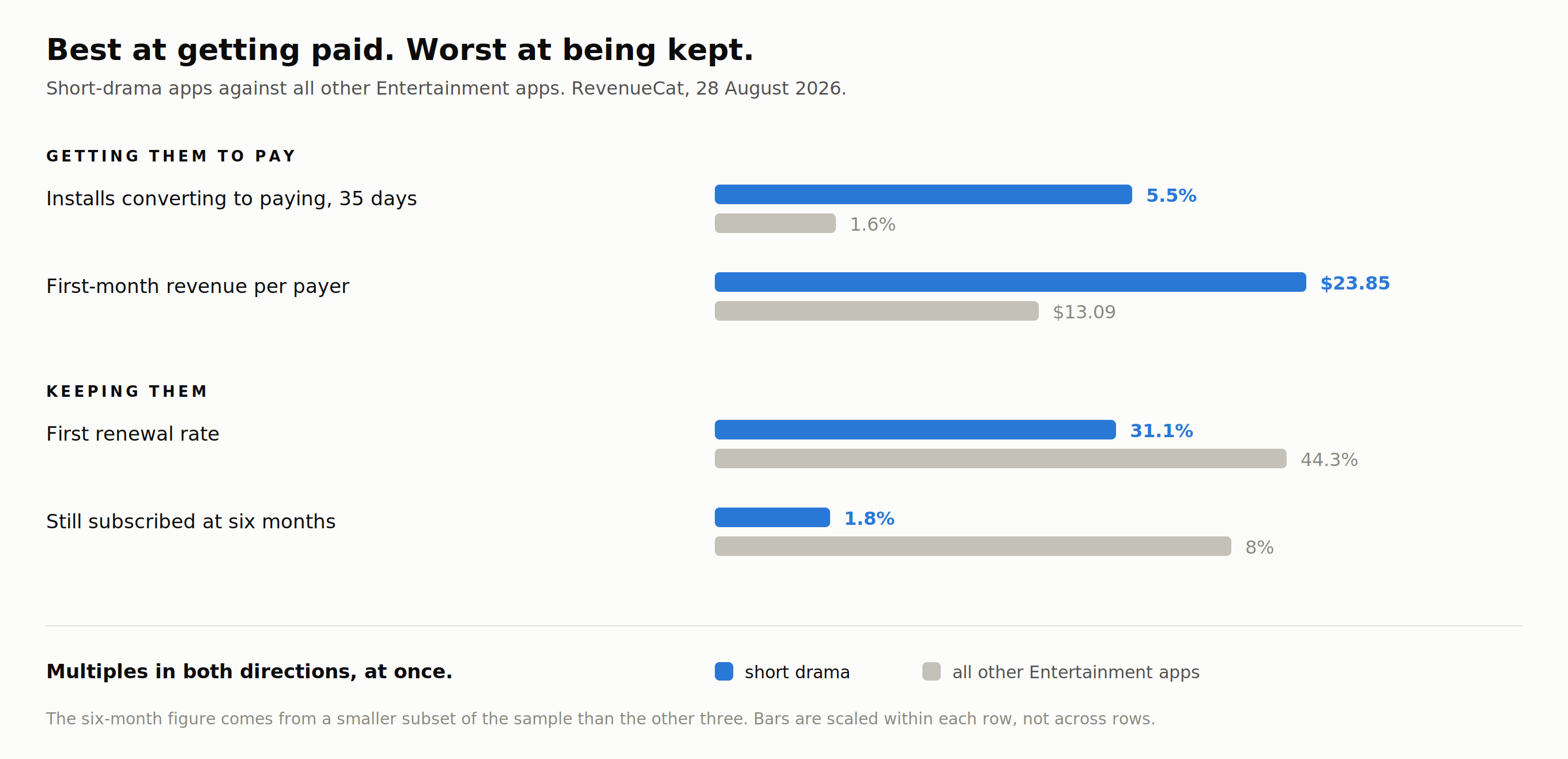
The number. For the median short-drama app, 5.5 percent of installs became paying customers within 35 days. For other Entertainment apps, 1.6 percent. Six months later, in the smaller group of apps where retention could be measured, 1.8 percent of short-drama subscribers were still paying, against 8 percent for the rest of Entertainment. Three and a half times better at getting paid. More than four times worse at being kept. Both from the same dataset, published on the same day.
The source. RevenueCat, 28 August 2026, an analysis of short-drama apps against the rest of the Entertainment category, written by Rik Haandrikman. The app population comes from Appfigures: over 5,000 of the highest-grossing non-game Entertainment apps, roughly 360 of them short drama. Three things to read before the numbers. They are medians across apps, not titles. Conversion is install-to-paid within 35 days, not trial-to-paid, so a free-to-download app with unlocks counts the same as a subscription app. And the six-month figure comes from a smaller group whose size RevenueCat does not state; it flags the caveat, and so do I. One source, one dataset. I have not seen a second measurement of six-month retention for this category, so 1.8 is a first reading, not a settled fact.
What it says. The category is built for the purchase, not the relationship, and the rest of the same report shows how. Weekly plans are 88.5 percent of short-drama recurring revenue, against 14.3 percent for other Entertainment apps, and the most common weekly price is $9.99, about twice the $4.99 the rest of the category charges. Nobody is building a twelve-month relationship at $9.99 a week. A product whose every incentive points at the first ten minutes will be superb at the first ten minutes. Acquisition was never the problem. 5.5 percent is not a problem. The problem is 1.8.
Where the data ends. It is global and app-level. It cannot tell you whether a Telugu, Tamil or Hindi short-drama subscriber behaves like the median app’s, because no Indian platform publishes six-month retention, and none publishes completion or cohort retention by title. It cannot tell you whether the show that converts is the show that keeps, because the two numbers were never joined at title level anywhere. And it cannot tell you what happens at the second renewal, the point where someone has finished the thing they came for and decides whether this is a service or a purchase. What I would decide anyway, if the slate were mine: instrument completion and cohort retention on one chart, reported to one person, before commissioning the next hundred titles. It is the cheapest fix available, and almost nobody does it.
The long version, with the Indian market figures and the counter-arguments, is part two of the commissioning series: Best at Getting Paid. Worst at Being Kept.